Before you leave, we invite you to talk directly with our managing team to ensure you receive the most accurate technical guidance, pricing support, and customization options for your project. Our experts can quickly evaluate your requirements, recommend suitable sintered plastic filter solutions, and help you reduce sourcing risks while improving efficiency, consistency, and long-term supply stability for your industrial applications.
Need Help Selecting the Right Filter Cartridge?
Our Sales Team
Tell our sales support team your product type, micron rating, size, application, filtered medium, working temperature, pressure, and estimated quantity. We will help you match the right sintered plastic, sintered metal, or sediment filter cartridge.
What Is a Five-Layer Sintered Mesh Filter and How Does It Work?
A five-layer sintered mesh filter is a rigid porous metal sheet made from five woven wire layers that are stacked and bonded by heat and pressure. The layers are not copies of one another. One protects the filter layer, one sets the retention rating, one spreads flow, and two give the structure its strength. The result is a metal medium that can be rolled into cartridges or cut into discs. Most designs can be cleaned and reused, though cleaning methods and limits vary by construction.
For engineers and buyers, the practical question is what the five-layer construction improves compared with a single woven screen or a sintered powder element. It also matters where the design stops being the right answer. The sections below cover both.
How a Five-Layer Sintered Mesh Is Built
Sintering joins the wire layers at their contact points without melting the wire into a solid block. Manufacturers stack calendered or woven meshes in a defined sequence, then heat them under pressure, often in a vacuum or controlled atmosphere. One manufacturer describes the process as stacking five functional layers followed by vacuum sintering and flattening. The finished sheet resists wire displacement and layer slippage, which are common failure points in loose stacked screens.
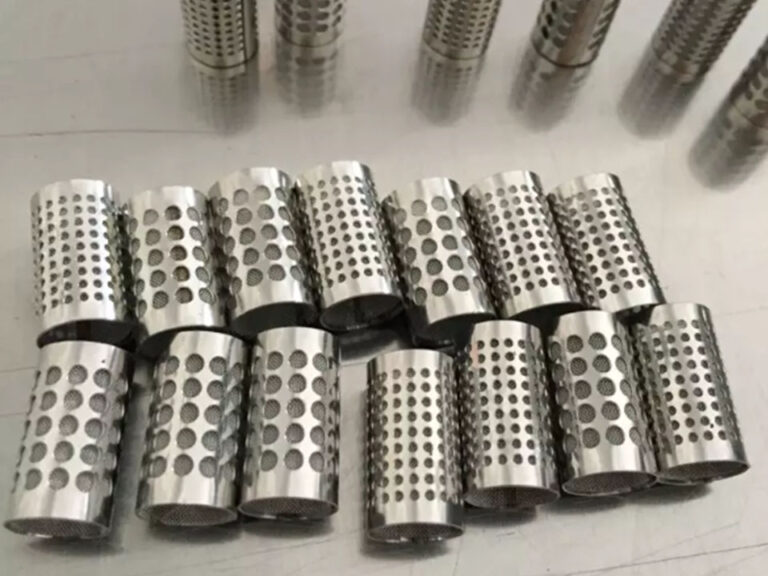
The sintered sheet is then cut, formed, rolled, and welded into the final element. Welding and forming matter because they define the true usable strength of a cartridge. The strength of the flat laminate alone does not.
What Each Layer Does
Layer sequence varies between manufacturers, so treat the table below as a representative arrangement. It follows the structure described in technical literature on five-layer sintered wire cloth and in the supplier description above.
Layer position
Typical function
What it means in service
1. Protective layer
Shields the fine layer from damage
Reduces mechanical damage during fabrication, handling, and cleaning
2. Filtration layer
Sets the retention rating
This is where most particle separation happens
3. Distribution layer
Spreads flow and drains the filtration layer
Helps limit local flow concentration and stabilizes pressure drop
4. Support layer
Carries pressure load
Prevents the fine mesh from deflecting
5. Support layer
Adds rigidity
Helps the element hold shape during forming, welding, and cycling
The sintered mesh filter page from CFC Filtration describes a similar logic using protective, fine filtration, reinforcement, and structural support layers. Exact mesh counts, wire diameters, and layer order depend on the specific product and should be confirmed in the drawing or datasheet.
How the Filter Works in Operation
Fluid enters through the protective side and meets the fine filtration layer. Particles larger than the effective pore opening are stopped at or near that surface. Smaller particles may pass, or they may lodge in the irregular openings between wires. Filtered fluid then moves through the distribution layer and exits through the support layers.
The design is mainly surface-dominant. A sintered powder element or a sintered fiber felt element creates a thick, tortuous pore network where particles are captured throughout the depth of the medium. A five-layer mesh usually concentrates retention in one thin layer, with only a limited depth effect from the surrounding layers. That is not a defect. It is the reason the medium tends to clean well. Solids that collect on the face can often be removed by backwashing, while particles trapped deep in a thick medium are harder to dislodge. The trade-off is that dirt-holding capacity per unit of area is generally lower than in thicker depth media, so surface area and cleaning frequency matter more.
Pressure Direction and Backwashing
Support layers are designed to resist pressure applied from the filtration side toward the support side. Reverse pressure during backwashing loads the structure differently. If the process uses backwashing, ask the supplier to confirm both the forward differential pressure limit and the allowable reverse pressure for the actual cartridge configuration. Do not assume the two are equal.
Technical literature on sintered wire cloth notes that smooth laminate surfaces help cleaning methods such as backwashing. Whether a given element can be restored depends on the contaminant. Hard particles usually release well. Sticky, polymeric, or very fine particles can embed in the pores and may need chemical or ultrasonic cleaning instead.
Micron Rating: Read It Carefully
A micron rating on a sintered mesh filter describes the filtration layer’s retention capability under a specific test method. Some suppliers publish an absolute rating, and others publish a nominal one. These are not interchangeable, and a stated rating does not guarantee that no larger particle will ever pass.
Three points deserve attention:
Particle shape. Woven wire apertures are defined by wire spacing. Fibers and elongated particles can pass through openings that would stop a sphere of the same length.
Test method. Ask whether the rating comes from a glass bead challenge, a bubble point test, or another method, and whether the data applies to the finished cartridge or to flat sheet only.
Operating conditions. Pressure surges, high viscosity, and flow pulsation can shift real-world retention away from laboratory values.
The product information on CFC Filtration’s sintered mesh page lists a customizable rating range of 1–100 microns and SS304, SS316L, or custom alloy mesh options. Any project-specific rating, material, and tolerance still needs to be confirmed against a drawing or datasheet for the actual part.
How It Compares With Other Metal Filter Media
No single sintered medium is best for every duty. The table compares general characteristics only and should not be read as product specifications.
Characteristic
Five-layer sintered mesh
Single woven mesh screen
Sintered metal powder
Sintered metal fiber felt
Structure
Bonded woven layers
One unbonded layer
Fused powder, thick pore network
Fused fibers, high porosity
Retention behavior
Mainly surface
Surface
Depth and surface
Mainly depth
Rigidity
High when supported
Low to moderate
High
Depends on support
Dirt-holding tendency
Lower per unit area
Low
Moderate
Generally higher
Cleanability
Typically good for solids
Good for coarse solids
Varies with pore depth
Varies with contaminant
Typical use case
Backwashable, pressure-loaded duty
Coarse straining
Fine, stable depth filtration
High-capacity fine filtration
Choose five-layer mesh when you need a repeatable surface barrier, mechanical strength, and cleanability. Consider powder or felt when the stream carries a high solids load, or when the process benefits from capture across the thickness of the medium. The sintered metal filter cartridge range from CFC Filtration covers powder, mesh, felt, pleated, and perforated-plate composite constructions, so the comparison can start from the process rather than the product category.
Specification Checklist Before You Request a Quote
A complete inquiry saves several rounds of correspondence. Collect the following:
Fluid and contaminants: liquid, gas, or steam; particle type and size range; solids concentration; fouling tendency.
Target retention: required micron value, whether nominal or absolute, and the acceptance method.
Operating conditions: temperature range, working pressure, maximum differential pressure, and whether the process has surges or cycling.
Flow and pressure drop: design flow rate, viscosity, and the maximum allowable clean pressure drop.
Material and chemistry: the actual process fluid and cleaning agents. Stainless grades are not equally resistant to chlorides, acids, or reducing conditions, and compatibility must be checked against the real fluid.
Cleaning method: backwash, backflush, ultrasonic, chemical, or replacement only.
Mechanical details: diameter, length, end fittings, seal type, and housing drawing.
Specifying only the micron rating. Pressure drop, strength, and cleanability are equally decisive.
Ignoring weld and seal design. A strong laminate can still leak at a poorly designed seam or end cap.
Assuming reuse is unlimited. Cleaning effectiveness depends on the contaminant, and repeated cycles can leave residual loading.
Treating “stainless” as a guarantee. Material grade must match the fluid chemistry and temperature.
Overlooking dirt-holding capacity. A thin surface medium in a high-solids stream may need a prefilter or a larger element area.
Frequently Asked Questions
Is a five-layer sintered mesh filter the same as a woven wire mesh filter?
No. A woven mesh filter is a single layer or loose stack of layers held in a frame. A five-layer sintered mesh has layers bonded together, which improves rigidity and layer stability. That makes it better suited to pressure and cleaning cycles.
Can it filter liquids and gases?
It is used in both, depending on the construction and the process. Fluid properties, pressure, and required retention should be reviewed before selecting a specific element.
Is it truly reusable?
It is generally designed for cleaning and reuse, but results depend on what is trapped in it. Hard particulate often backwashes well. Sticky or very fine contaminants can be harder to remove. Ask for a cleaning recommendation based on your actual contaminant.
Does a five-layer structure give a finer micron rating than a single layer?
Not by itself. The filtration layer sets the rating. The other layers protect it, distribute flow, and provide strength.
What maximum temperature and pressure can it handle?
There is no universal figure. Limits depend on the alloy, wire sizes, layer configuration, welding, end fittings, and service conditions. Request ratings for the exact cartridge design.
How does it differ from a sintered powder filter?
Powder elements form a thicker pore network with a stronger depth effect. Five-layer mesh concentrates retention in one engineered layer and is usually chosen for cleanability and pressure resistance.
Choosing the Right Construction
A five-layer sintered mesh filter works because each layer has a defined job: protect, retain, distribute, and support. It is a strong candidate when the duty involves pressure, repeated cleaning, and a need for stable metal media. It is a weaker fit when the stream carries heavy solids loads that favor depth media. The decision should rest on the full operating picture rather than micron rating alone.
If you are evaluating a sintered mesh cartridge for a new design or a replacement project, send your operating conditions, drawings, or existing part details to CFC Filtration. The engineering team can discuss suitable materials, layer configurations, and cartridge formats for your application.