Before you leave, we invite you to talk directly with our managing team to ensure you receive the most accurate technical guidance, pricing support, and customization options for your project. Our experts can quickly evaluate your requirements, recommend suitable sintered plastic filter solutions, and help you reduce sourcing risks while improving efficiency, consistency, and long-term supply stability for your industrial applications.
Need Help Selecting the Right Filter Cartridge?
Our Sales Team
Tell our sales support team your product type, micron rating, size, application, filtered medium, working temperature, pressure, and estimated quantity. We will help you match the right sintered plastic, sintered metal, or sediment filter cartridge.
Perforated Plate Sintered Mesh vs Five-Layer Sintered Mesh: Key Differences
The main difference is structural. A five-layer sintered mesh is a laminate of woven wire cloths with defined jobs: protection, filtration, flow distribution, and support. Perforated plate sintered mesh adds a rigid perforated metal plate to a sintered mesh, so the plate carries mechanical load and the mesh does the filtering.
The two are not strict competitors. Many perforated plate composites use a multilayer sintered mesh as their filter layer. The question is whether your duty needs the extra backbone, or whether the mesh laminate can support itself.
That matters because the wrong choice shows up in service. A self-supporting mesh tube can deform under differential pressure. A plate-reinforced element can cost more and flow less than the application required.
How a Five-Layer Sintered Mesh Is Built
A standard five-layer sintered wire mesh stacks several woven wire cloths in a fixed order, then bonds them with heat and pressure, usually in a vacuum furnace. Supplier literature commonly describes the stack as:
Protective layer: a coarser mesh that shields the fine layer from abrasion and handling damage.
Filtration (control) layer: the fine mesh that sets the retention rating.
Dispersion layer: an intermediate mesh that spreads flow across the filtration layer.
Two support layers: heavier meshes that provide stiffness and keep the fine layer from being pushed through.
Exact layer order and mesh grades vary between manufacturers and grades. They are specified per application, so a “five-layer” label alone does not define a product.
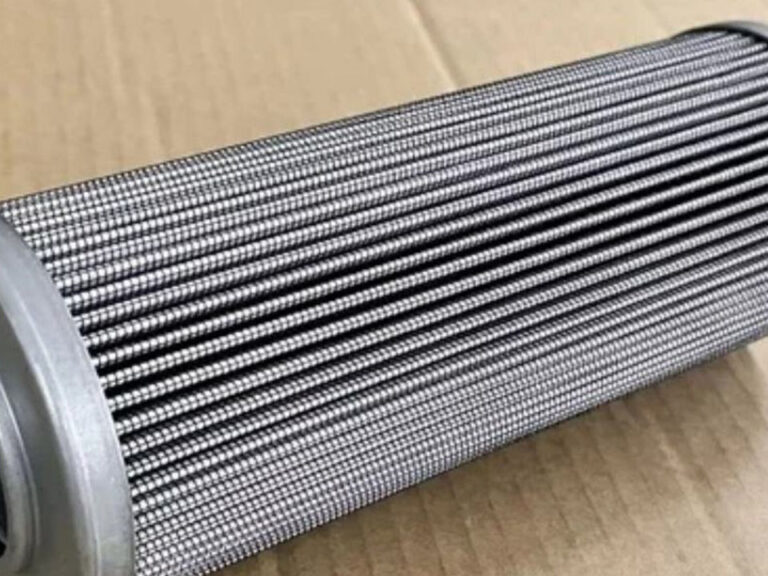
The result is a thin, fairly rigid sheet. It is rolled and seam-welded into tubes, cut into discs, or pleated. Its strength comes from the support meshes and the way the cartridge is formed. That is enough for many duties, but a sheet only a millimeter or two thick has a ceiling.
What the Perforated Plate Adds
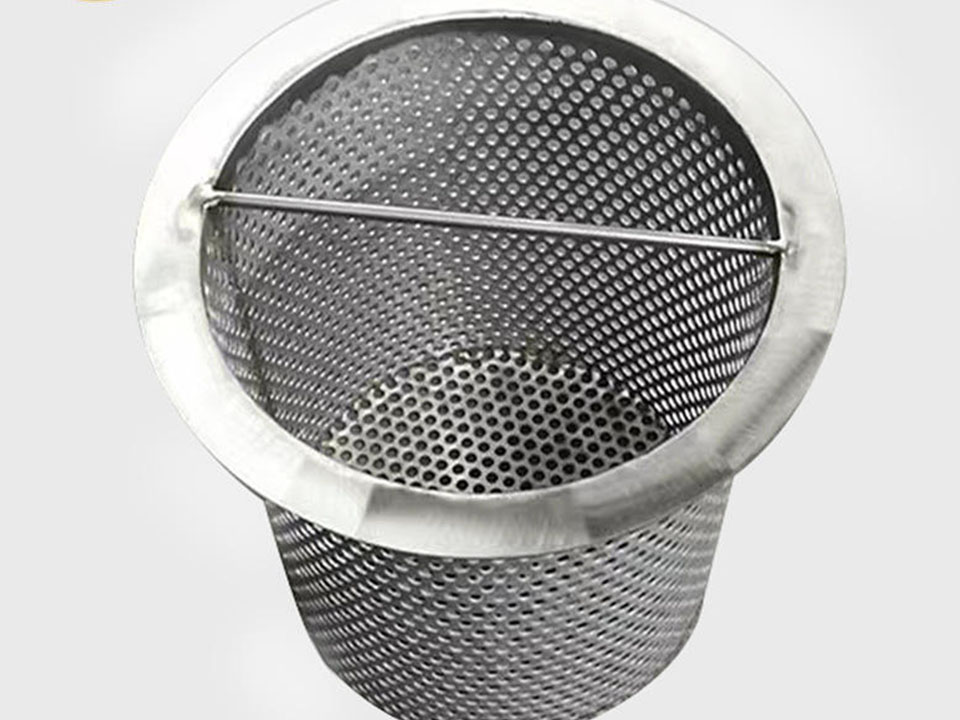
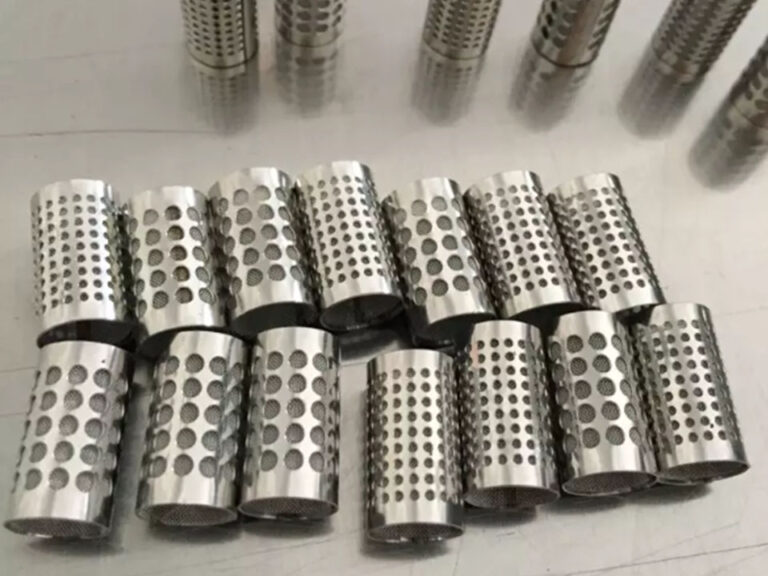
In a perforated plate composite, a punched or laser-cut metal plate is bonded to one or both faces of the sintered mesh. The plate usually has holes much larger than the filtration rating. It is not a filter. It is a load-bearing skeleton that prevents the mesh from bending, buckling, or tearing under pressure.
Depends on thickness, geometry, and any added support
Generally higher for a given diameter and length
Design variables
Mesh grades, layer arrangement, geometry
All of the above plus hole size, open area, plate thickness, plate position
Actual limits depend on alloy, thickness, geometry, and seam design. Neither column is a pressure rating.
Retention Rating: What Does Not Change
Adding a perforated plate does not make the filter finer. Retention is set by the filtration layer in both designs.
Buyers should still ask how the rating was defined. A nominal rating describes the size at which a stated fraction of particles is retained. An absolute rating describes the largest hole or pore a particle can pass through, and test methods differ. Bubble-point testing estimates the largest pore, but it does not by itself prove retention efficiency for your contaminant, fluid, and flow rate. Woven mesh also has a defined aperture rather than a random pore network. Particle shape and flow conditions still affect capture.
Flow Area and Pressure Drop
The plate has a cost in flow. Mesh sitting directly behind the solid land areas between holes sees less flow than mesh behind an open hole. The effective filtration area is therefore smaller than the nominal surface, and flow concentrates near the holes.
Open area helps. A plate with a high open-area ratio and well-placed holes reduces the penalty. A thick plate with small, sparse holes raises resistance and can cause uneven loading. CFC Filtration lists perforation diameter and open area among the design variables of its composite cartridges. Define them in your request instead of leaving them to a default.
A five-layer mesh without a plate uses nearly its full area. If the duty is low to moderate pressure and the cartridge can be supported by a core or cage, that open flow path is an advantage.
Direction of Flow and Backwash
Plate position should follow the pressure direction. Pressure pushes the mesh against whatever sits downstream of it. During forward flow, a plate on the downstream side supports the mesh. During a backwash, the load reverses, and the mesh may be pushed away from that plate.
For systems that backwash frequently or at high pressure, this matters more than any datasheet figure. Possible responses include plates on both faces, a tested bond design, or a reduced backwash pressure. Supplier literature such as DS Wire Cloth’s description of perforated plate composite mesh positions the format for high differential pressure, large particle impact, and frequent backwashing. Even so, confirm the flow direction and cleaning method against the design.
Tube geometry is another factor:
Outside-in flow puts external pressure on the tube, so buckling resistance is critical.
Inside-out flow puts hoop tension on the tube, so seam welds and end connections carry more of the load.
When Each Design Makes Sense
Choose a five-layer sintered mesh when
Differential pressure is moderate and well characterized.
The element is small to medium in diameter and length.
Maximum open flow area is a priority.
A core, cage, or housing supports the cartridge.
Weight and unit cost are significant.
The element will be pleated, where added plate stiffness would work against the pleat geometry.
Choose a perforated plate composite when
The element is large or long and must support itself.
Pressure surges, vibration, or pulsation are expected.
The system uses aggressive backwash cycles.
A filter failure would mean production loss or downstream contamination.
The design needs mounting points, welded structures, or heavier end hardware.
When neither is the best fit
If the contaminant load is high and fine, a deeper medium such as sintered metal powder or fiber felt may hold more dirt. If the application needs large filtration area in a small envelope, a pleated construction may serve better. Both are covered in the sintered metal filter cartridge range.
Common Specification Mistakes
Assuming “five-layer” defines the product. Mesh grades and arrangement vary widely.
Ignoring the cleaning method. Backwash, chemical cleaning, and ultrasonic cleaning each stress the structure differently.
Overlooking temperature cycling. Plate, mesh, and welds should be compatible in alloy and expansion behavior.
Choosing by micron rating alone. Flow, pressure drop, contaminant type, and fluid compatibility all affect the result.
Confirming chemical compatibility from a general alloy chart. Check the actual process fluid, concentration, and temperature.
Adding a plate when a cage would do. An unneeded plate adds cost and may reduce effective flow area.
What to Include in an RFQ
For either design, a complete request typically covers:
Fluid or gas, with viscosity and chemistry
Operating temperature and pressure range
Maximum differential pressure, including surge conditions
Flow rate and allowable pressure drop
Contaminant type, particle size, and loading
Required retention rating and how it should be verified
Flow direction and cleaning method, including backwash pressure
Alloy preference and compliance requirements
Drawings, housing dimensions, end connections, and sealing method
Is a perforated plate composite a different filter from a five-layer sintered mesh?
Usually it builds on one. The filter layer is typically a multilayer sintered mesh, and the plate is added for support. The difference lies in the structure around the media, not in a different filtration principle.
Does the perforated plate improve filtration accuracy?
No. The filtration layer sets the retention rating. The plate improves mechanical strength and can affect flow distribution, but it does not reduce the size of particles the element retains.
Which design is easier to clean?
Both are surface-type media that are commonly cleaned by backwashing. Cleanability depends on the contaminant, cleaning method, and construction. Plate-reinforced designs may better tolerate frequent or high-pressure backwash, provided the plate position matches the load direction.
Does the plate increase pressure drop?
It can. The solid areas between holes reduce the effective flow area of the mesh behind them. The effect depends on hole size, spacing, and open area, so compare candidates using actual flow and differential-pressure data for your fluid.
Can either design be used at high temperatures?
Stainless steel and alloy sintered meshes are used in thermally demanding processes. The allowable temperature depends on alloy, construction, atmosphere, and load. Treat any quoted limit as application-specific and confirm it against your operating conditions.
How do I decide quickly?
Start with the mechanical loads. If differential pressure, pulsation, size, or backwash severity are high, evaluate a perforated plate composite. If space, weight, flow area, or pleated geometry matter more, begin with a five-layer sintered mesh.
Choosing Between Support and Open Area
Perforated plate sintered mesh and five-layer sintered mesh differ in how much structure surrounds the filtration layer. The five-layer laminate maximizes open flow area and compactness. The plate-reinforced version adds stiffness and surge tolerance, at the cost of weight, price, and some effective area. Match the choice to your real pressure, cleaning, and size requirements.
If you are evaluating either construction, send CFC Filtration your operating pressure, temperature, fluid, target rating, cleaning method, and drawings or sample. Their engineers can then review a suitable mesh arrangement, support structure, and cartridge configuration for your system.