Before you leave, we invite you to talk directly with our managing team to ensure you receive the most accurate technical guidance, pricing support, and customization options for your project. Our experts can quickly evaluate your requirements, recommend suitable sintered plastic filter solutions, and help you reduce sourcing risks while improving efficiency, consistency, and long-term supply stability for your industrial applications.
Need Help Selecting the Right Filter Cartridge?
Our Sales Team
Tell our sales support team your product type, micron rating, size, application, filtered medium, working temperature, pressure, and estimated quantity. We will help you match the right sintered plastic, sintered metal, or sediment filter cartridge.
Sintered Metal Filters vs Stainless Steel Mesh Filters: What’s the Difference?
Sintered metal filters and stainless steel mesh filters differ mainly in how they hold back particles. A woven stainless steel mesh is a screen with defined openings, and it stops particles mainly at its surface. A sintered metal filter is a rigid porous body of bonded metal particles (or bonded mesh layers) with winding internal channels, and it captures particles at the surface and inside the structure. That difference affects micron rating, pressure drop, cleanability, mechanical stability, and price, so it is worth settling before you write an RFQ.
The comparison is often muddied by terminology. Suppliers use “stainless steel filter” for several different constructions, and a quotation that does not say which one is being offered cannot be compared fairly.
Three Constructions That Get Called “Metal Filters”
Woven wire mesh is a single layer (or a few loose layers) of wires woven in plain, twill, or Dutch patterns. The wires are held in place by weaving and friction. It is usually the most economical option and is used for strainers, coarse screens, and protective layers.
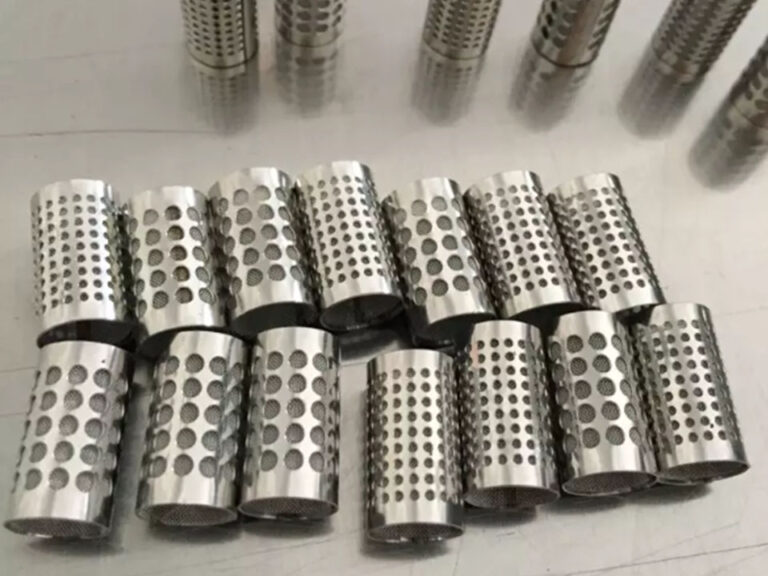
Sintered wire mesh stacks several layers of woven mesh and bonds them with heat and pressure. A typical build combines a fine filtration layer with protective and support layers. The wire crossings are fused, so the layers stop shifting against each other. CFC Filtration’s sintered metal filter cartridge range describes this construction as multilayer woven mesh joined by sintering.
Sintered metal powder is made by compacting and sintering metal powder into a rigid porous structure. The pores are the interconnected gaps between fused particles rather than openings in a weave. Details on this construction are on the page for sintered metal filters.
If someone asks “sintered vs mesh,” first find out whether they mean woven mesh or sintered mesh. The answer changes.
How Each One Captures Particles
Surface retention in woven mesh
A woven screen has openings of a defined size. A particle larger than the opening is stopped at the surface, and a smaller one passes unless something else intervenes. Because the openings are regular, behavior is relatively predictable. Dirt-holding capacity is limited, though. Captured solids collect on one face, and fine particles can wedge into the openings and blind the screen. Elongated or flexible particles such as fibers can also pass through openings smaller than their length.
Depth and surface retention in sintered powder media
In a sintered powder element, the fluid follows tortuous paths through interconnected pores of varying size. Particles are stopped at the surface and also lodge within the pore network, so the element can hold more solids before the pressure drop becomes a problem. The tradeoff is that those internal deposits are harder to remove completely. The pore-size distribution is also broader than the opening-size tolerance of a woven screen, which matters when you read a micron rating.
Where sintered mesh fits
Sintered mesh sits between the two. Retention is still defined mainly by the openings in the finest mesh layer, but the bonded stack is much stiffer and keeps the layers from shifting.
Side-by-Side Comparison
Factor
Woven stainless steel mesh
Sintered wire mesh
Sintered metal powder
Pore structure
Regular openings set by the weave
Defined by the finest layer, supported by backing layers
Irregular, interconnected channels
Main retention behavior
Mostly surface
Mostly surface, with some layer effect
Surface plus depth
Dirt-holding capacity
Generally lowest of the three
Moderate
Generally higher, depending on porosity and thickness
Rating basis
Opening size and weave specification
Opening size of filter layer, often verified by bubble point
Usually bubble point or a retention test, with pore-size distribution
Mechanical rigidity
Can distort or shift under pressure and vibration
Rigid and self-supporting
Rigid and self-supporting
Cleanability
Often easy to rinse or backflush, but fine mesh can blind
Typically cleanable by backflushing; fouling pattern depends on design
Cleanable in many cases, but deep fouling can be harder to reverse
Typical cost position
Lowest
Middle
Depends on geometry, material, and rating
This table shows general tendencies, not product specifications. The actual values for any element depend on the weave, powder grade, thickness, and manufacturing process.
Micron Ratings Are Not Comparable Across Constructions
A “20 micron” label can mean different things on each media type.
For woven mesh, the number usually refers to the opening size, so a spherical particle larger than that opening should be stopped. In practice, particle shape, wire tolerance, and weave consistency all affect real retention.
For sintered powder media, pore sizes vary, and the narrowest constrictions along a flow path control retention. Pore size is typically characterized with methods such as bubble point or capillary flow porometry. The Porometer overview of pore size measurement in metal filter media notes that perforated sheets have predictable, uniform pores while sintered structures have tortuous, irregular channels, and that irregular pore necks make characterization harder. Capillary flow porometry can report bubble point, mean flow pore size, smallest pore, and pore-size distribution.
Two elements both labeled “20 µm” can therefore behave differently on the same fluid. When comparing quotations, ask each supplier:
Is the rating nominal or absolute?
What test method produced it (bubble point, particle challenge, or aperture specification)?
Is there a retention efficiency target at the stated size?
A micron number alone does not guarantee that all larger particles are removed.
Pressure Drop, Flow, and Strength
Pressure drop depends on open area, thickness, pore size, fluid viscosity, and flow rate. A coarse woven screen often has a very low pressure drop, since it is thin and open. As you move to finer retention, a sintered element’s thicker, tortuous structure usually produces higher resistance at the same flow, so filtration area becomes the main design lever. This is where pleated stainless steel sintered filter cartridges come into play, because pleating increases the effective area within the same housing envelope. Whether that benefit justifies the construction cost depends on your allowable pressure drop and cleaning plan.
On strength, unsintered mesh can deform or open up under differential pressure, pulsation, or vibration. Sintered structures are bonded, so they generally resist this better, and sintered powder elements also resist media migration. Actual pressure and temperature limits depend on the alloy, wall thickness, geometry, end-cap design, and service conditions. Do not read a limit off a general material description. Ask for the rating on the specific element and the fluid it will see.
Cleaning and Service Life
Cleanability is often what decides the comparison.
Woven mesh can often be rinsed, brushed, or backflushed. The risk is blinding in the finest weaves and damage to the delicate wires during aggressive cleaning.
Sintered mesh usually backflushes well because particles collect mainly at the filtering layer. The fouling pattern depends on how the layers are built.
Sintered powder can be backflushed, ultrasonically cleaned, or chemically cleaned in many cases, but particles lodged deep in the pores may not fully release. Recovered differential pressure after cleaning is the practical test.
Not all sintered filters clean the same way, and reusability should be confirmed for your contaminant, not assumed. Sticky solids, oils, polymers, and fine gels can foul any metal media quickly, and the cleaning method has to be compatible with both the media and the process.
Corrosion and Material Choice
Both families are commonly made from stainless steel such as 304 or 316L, with other alloys and titanium available for more demanding fluids. Material grade should be chosen from the actual process fluid, temperature, and cleaning chemicals, not from the filter type. Porous media have a large internal surface area and many small crevices, so corrosion exposure deserves a careful look, particularly with chlorides or aggressive cleaning agents. Never treat chemical compatibility as confirmed until the process fluid has been reviewed.
Which One Fits Which Job
Woven mesh generally makes sense when:
The filtration requirement is coarse
Pressure and vibration are modest
The element works as a strainer or a protective screen
Low initial cost matters more than dirt capacity
Sintered mesh is worth considering when:
You want a defined opening size with better rigidity
Backflushing is part of the operating plan
The element must resist deformation or layer shifting
Sintered powder is typically the stronger candidate when:
Fine retention is needed along with strength
Deeper particle capture suits the contaminant load
Shedding or media migration would cause downstream problems
None of these is universally better. A cheaper mesh used in a duty it cannot support can end up costing more in downtime and replacements, and an over-specified sintered element adds cost without benefit.
What to Include in an RFQ
To get comparable quotations, send:
Fluid or gas, viscosity, and solids type and concentration
Required retention size and how it should be verified
Flow rate and allowable clean and terminal pressure drop
Operating temperature and pressure, including upsets and pulsation
Cleaning method and expected cleaning frequency
Housing type, dimensions, end connections, and sealing arrangement
Material requirements and any regulatory or documentation needs
Is a sintered metal filter better than a stainless steel mesh filter?
Not in every case. Sintered media typically offers more rigidity, finer retention options, and depth capture, while woven mesh offers lower cost and often simpler cleaning for coarse duties. The right choice depends on the contaminant, pressure conditions, and cleaning plan.
Is sintered wire mesh the same as sintered metal powder?
No. Sintered wire mesh bonds layers of woven wire, and its retention is set mainly by mesh openings. Sintered powder is a porous body made of fused metal particles. Their pore structures, pressure drop behavior, and fouling patterns differ.
Can a woven mesh filter provide absolute filtration?
Within limits. The opening size defines a clear cutoff for spherical particles, but weave tolerances, particle shape, and deformation under pressure can affect real retention. If retention matters, ask for the rating basis and test method in writing.
Which is easier to clean?
Coarse woven mesh and sintered mesh are usually easier to clean because solids collect near the surface. Sintered powder media can be cleaned in many applications, but deep fouling may reduce recovery. Test cleaning with your own fluid when possible.
Does a sintered metal filter remove dissolved contaminants?
No. These are mechanical particle filters. They do not remove dissolved substances, and removal of microorganisms or other specific contaminants should not be assumed without supporting test data for the application.
Conclusion
The practical question is not which element is “stronger” or “finer” in general but which construction matches the duty. Woven mesh suits coarse, low-stress separation. Sintered mesh adds rigidity and defined openings. Sintered powder adds depth retention and structural stability at a higher cost and with more careful cleaning requirements. Check how any micron rating was derived before you compare quotations, and specify fluid, pressure drop, temperature, and cleaning method together.
If you are weighing mesh against sintered media for a specific system, share your operating conditions, drawing, or current cartridge model with CFC Filtration. The engineering team can review the application and discuss suitable materials and cartridge configurations.