Before you leave, we invite you to talk directly with our managing team to ensure you receive the most accurate technical guidance, pricing support, and customization options for your project. Our experts can quickly evaluate your requirements, recommend suitable sintered plastic filter solutions, and help you reduce sourcing risks while improving efficiency, consistency, and long-term supply stability for your industrial applications.
Need Help Selecting the Right Filter Cartridge?
Our Sales Team
Tell our sales support team your product type, micron rating, size, application, filtered medium, working temperature, pressure, and estimated quantity. We will help you match the right sintered plastic, sintered metal, or sediment filter cartridge.
What Is a Cartridge Filter in the Pharmaceutical Industry?
In the pharmaceutical industry, a cartridge filter is a replaceable filter element installed in a housing to remove particles, and in some cases microorganisms, from liquids or gases during manufacturing. It may clarify a process fluid, protect downstream equipment, filter vent air, or, in the case of sterilizing-grade membrane cartridges, support sterile filtration.
These roles are not interchangeable. A cartridge that is fine for removing particles upstream is not automatically suitable for sterile filtration, and in a regulated process the documentation and testing behind a cartridge matter as much as its micron rating. This guide explains the main types, where they sit in a process, and what to confirm before you specify one.
What a Pharmaceutical Cartridge Filter Is
A cartridge filter system has a housing, a replaceable cylindrical element, and seals that keep unfiltered fluid from bypassing the element. The element may be a pleated membrane, a depth medium, or a rigid porous structure.
Two broad families appear in pharmaceutical work:
Prefilters and depth filters remove particles and protect downstream membranes or equipment.
Sterilizing-grade membrane cartridges are designed and validated for bacterial retention. A study on sterilizing-grade membrane cartridge filters notes that assurance of their bacterial retention relies on a multitiered approach: the filter manufacturing process, product validation, membrane and device release tests, end-user validation, and integrity tests.
One manufacturer’s support guide similarly distinguishes validation documents for prefilter products from those for sterilizing-grade membrane filter products. The two are validated differently.
Where Cartridge Filters Are Used in a Process
Role
Purpose
Typical considerations
Prefiltration
Remove particles before finer filtration or equipment
Keep particles out of pumps, instruments, or lines
Pressure rating, dimensions, connections
The table shows typical functions, not a standard classification. The right type depends on the product, the process step, and the regulatory expectations for your market.
Prefilter vs Sterilizing-Grade Filter
A micron number alone does not make a filter sterilizing-grade. Sterilizing-grade performance is established through validation, usually with a bacterial challenge, and through integrity testing. Sterilizing-grade filters are often rated at 0.2 or 0.22 microns, but the rating by itself does not qualify a filter.
Integrity tests are central to this. The study cited above explains that sterilizing-grade filters are typically integrity-tested after assembly and before use, and again after use, as per industry and regulatory guidelines. It also reports that a bubble point test confirms the pore-size rating but was relatively insensitive to defect size in the filters studied. The authors support pairing it with a gas–liquid diffusion test, which is better suited to detecting defects. Test methods and acceptance criteria belong in the filter’s validation documentation, so request them from the supplier.
Documentation to Request
Requirements differ by product, process, and region, so ask your quality team what applies. As an example of what a manufacturer may supply, one integrity testing support guide lists the following in its validation documents:
Technical specifications
Biological safety testing, including USP <88> Class VI
Extractables testing
Purified-water filtration quality data, including TOC, bacterial endotoxins, conductivity, and particle release
Chemical compatibility and thermal stability information
Correlation of a non-destructive integrity test to a defined bacterial challenge
That list reflects one manufacturer’s documents, not a universal requirement. For general regulatory context, the FDA’s guidance on sterile drug products produced by aseptic processing is a non-binding document from September 2004. Its contents include sections on components and on validation of aseptic processing and sterilization. Always check the current requirements for your market.
Media and Material Choices
Material selection depends on the fluid, the sterilization method, and the role of the filter. Polyamide (nylon) membranes are described by one membrane manufacturer as chemically resistant to alkaline solutions and organic solvents, while PTFE membranes are described as permanently hydrophobic with broad chemical compatibility, suited to air and gas filtration, in that company’s membrane filter guide. Compatibility must be confirmed with the actual fluid, concentration, and temperature, including cleaning and sterilization conditions.
Where Sintered Plastic Cartridges Fit
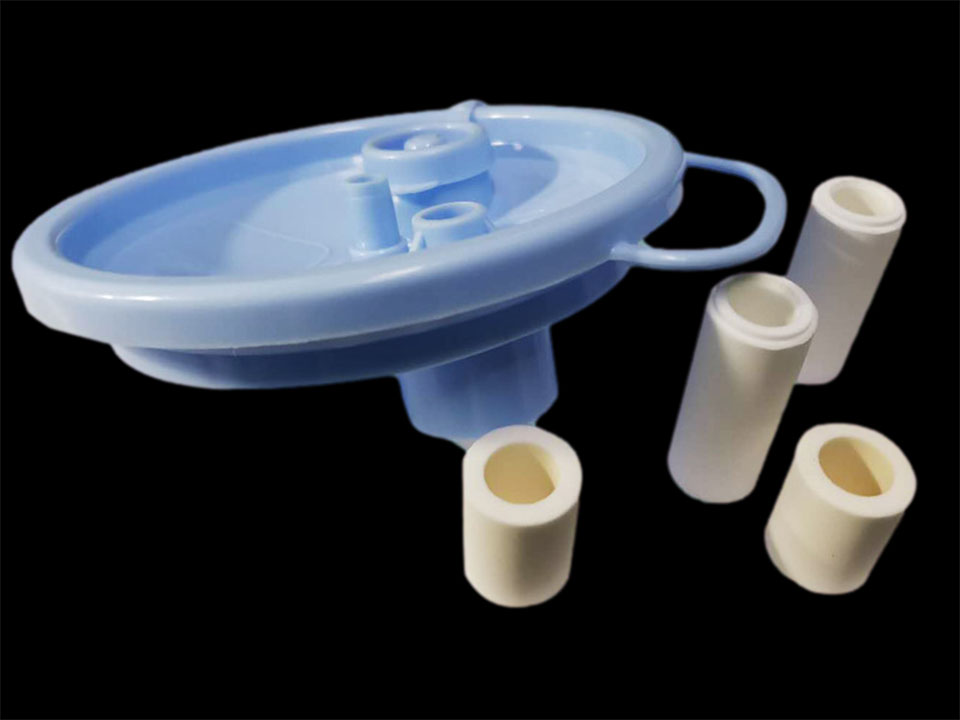
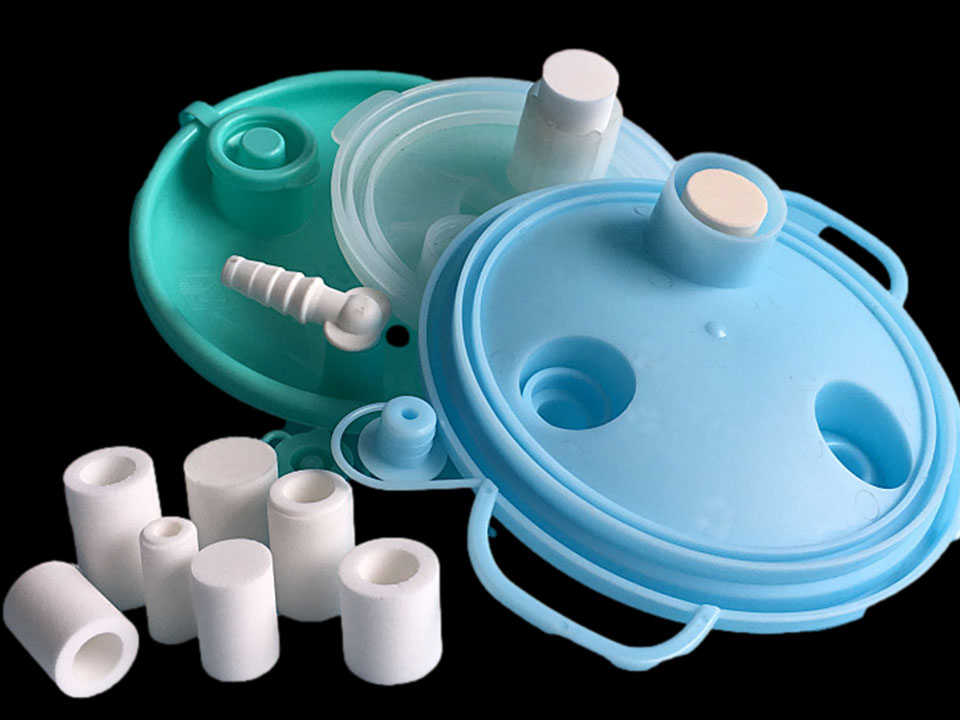
Sintered plastic cartridges are rigid porous elements. They are not usually positioned as sterilizing-grade membrane filters. They may play supporting roles, such as venting, diffusion, liquid management, particulate control, and equipment protection.
CFC Filtration describes this scope on its application overview page. It states that sintered plastic cartridges support filtration, venting, diffusion, liquid management, particulate control, and equipment protection. It also says each application requires a separate review of media compatibility, cartridge geometry, performance targets, and validation requirements. The company notes that porous plastic components may be developed for medical devices, diagnostic equipment, fluid handling, instrument protection, and air management, and that medical projects normally require additional information.
Application and process step, such as prefiltration, venting, or equipment protection
Fluid or gas, with composition, concentration, and pH
Continuous and peak temperature, including cleaning and sterilization conditions
Sterilization method, such as steam, gamma, or chemical
Working pressure and maximum differential pressure
Required flow rate and acceptable pressure drop
Particle type and size, and the retention target with its test basis
Housing details, dimensions, and end connections
Required documentation and testing, as defined by your quality team
Estimated quantity and replacement frequency
Frequently Asked Questions
What is a cartridge filter in pharmaceutical manufacturing?
It is a replaceable filter element installed in a housing to remove particles or microorganisms from liquids or gases. Types range from depth prefilters to validated sterilizing-grade membrane cartridges.
Is a cartridge filter the same as a capsule filter?
Not exactly. A cartridge is the replaceable element that goes into a separate housing. A capsule is a self-contained, pre-assembled unit. Which one fits depends on the process, cleaning, and validation approach.
What does sterilizing-grade mean?
It refers to a filter validated to retain bacteria under defined conditions and supported by integrity testing. The micron rating alone does not make a filter sterilizing-grade.
Why are integrity tests important?
They check that a filter is free of defects that could compromise retention. Sterilizing-grade filters are typically tested after assembly and before use, and again after use, per industry and regulatory guidelines.
Can a sintered plastic cartridge be used in pharmaceutical processing?
It may support roles such as venting, diffusion, particulate control, and equipment protection, but suitability must be reviewed for each application. Confirm material, documentation, and validation requirements with the supplier and your quality team.
Conclusion
A pharmaceutical cartridge filter is defined by its role in the process, not just its size or micron rating. Prefilters protect equipment and reduce particulate. Sterilizing-grade membrane cartridges depend on validation and integrity testing. Specify the role first, then the material, then the documentation your quality system requires.
If you are evaluating porous plastic elements for venting, particulate control, or equipment protection, share your fluid, temperature, sterilization method, pressure, flow, and documentation requirements with CFC Filtration. The team can discuss suitable materials and custom configurations for your application.