Before you leave, we invite you to talk directly with our managing team to ensure you receive the most accurate technical guidance, pricing support, and customization options for your project. Our experts can quickly evaluate your requirements, recommend suitable sintered plastic filter solutions, and help you reduce sourcing risks while improving efficiency, consistency, and long-term supply stability for your industrial applications.
Need Help Selecting the Right Filter Cartridge?
Our Sales Team
Tell our sales support team your product type, micron rating, size, application, filtered medium, working temperature, pressure, and estimated quantity. We will help you match the right sintered plastic, sintered metal, or sediment filter cartridge.
Nylon (PA) sintered filters are used where a rigid, mechanically tough porous element has to handle oils, fuels, certain solvents, or demanding flow conditions, and where PE or PP may not be the best fit. Typical uses include hydraulic and lubrication fluid filtration, fuel and coolant lines, venting and gas diffusion, and protection of pumps, valves, and instruments. They are not a general-purpose choice. Nylon absorbs moisture and is attacked by strong acids and oxidizers, so the process fluid decides whether it works.
This guide explains what nylon sintered media does well, where it is typically specified, and what buyers should confirm before ordering.
What a Nylon (PA) Sintered Filter Is
A sintered nylon filter is made by bonding polyamide powder with heat and controlled pressure. The particles fuse at their contact points without fully melting, which leaves a rigid body with interconnected pores. Sintered porous plastics are generally formed this way. Porex notes that polypropylene and polyethylene are the most common, with other polymers chosen for specific chemical and additive compatibility. Nylon is one of those alternatives.
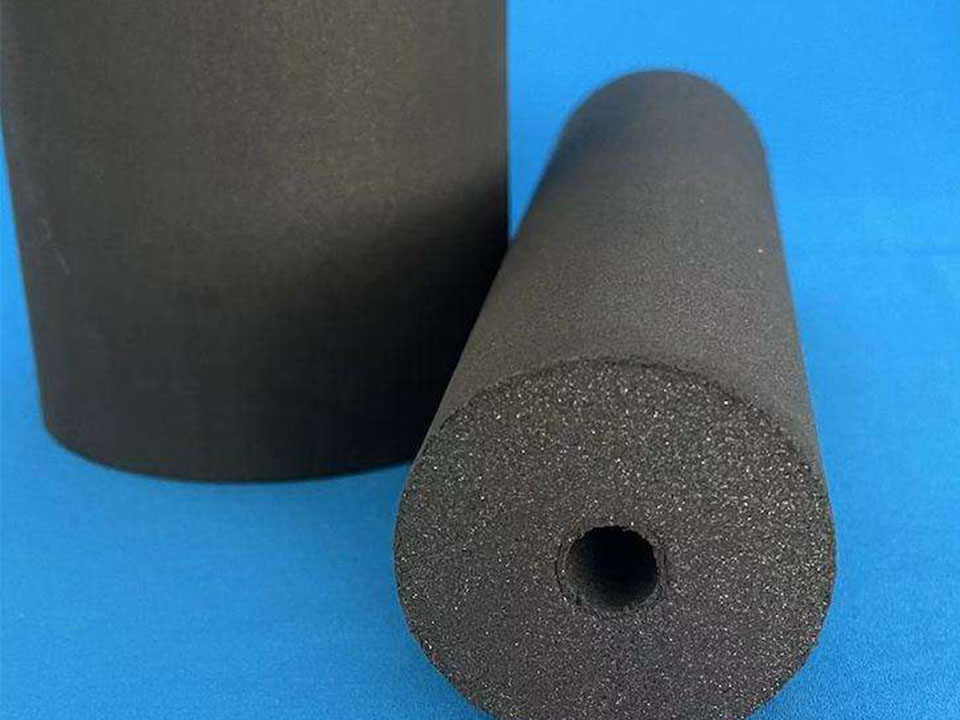
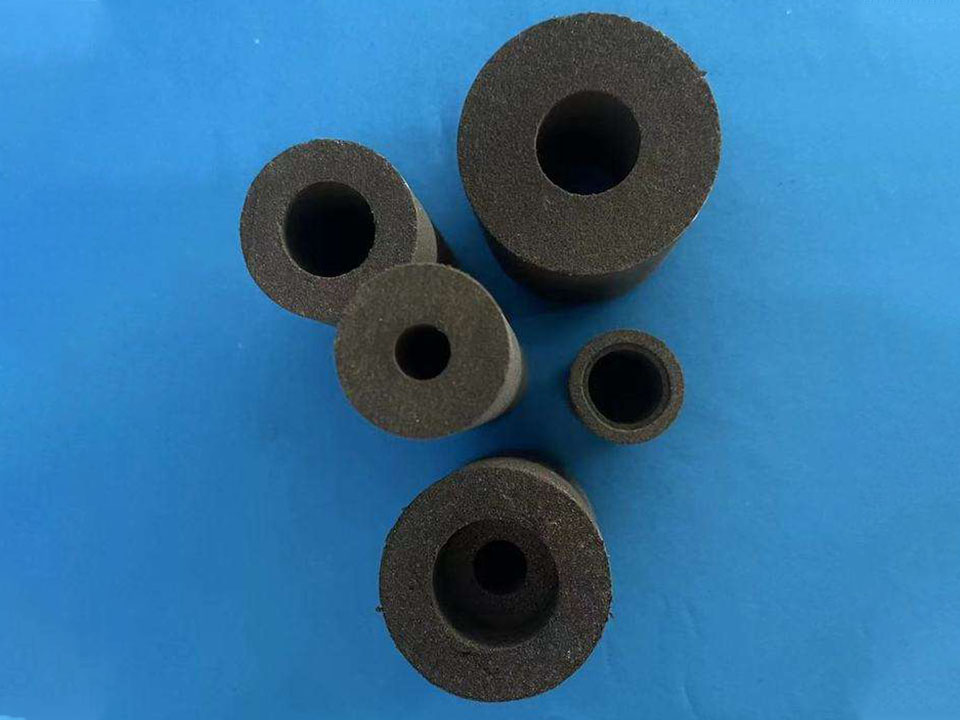
Fluid passes through the tortuous pore network, and particles are retained mainly by depth filtration, plus some surface capture. Because the body is rigid, it can be machined or molded into tubes, cylinders, discs, cups, and custom shapes. CFC Filtration lists nylon alongside PE, PP, PTFE, and other engineering plastics in its sintered plastic filter cartridge range.
“Nylon” also covers several polyamide families, such as PA6, PA66, PA11, and PA12. They differ in moisture uptake, stiffness, and melting behavior. Always confirm which grade a supplier is proposing instead of assuming a generic “PA.”
Why Engineers Choose Nylon Over Other Sintered Plastics
Three characteristics usually drive the decision. These are general polyamide traits, not the specifications of any particular cartridge.
Mechanical toughness. Polyamides are generally tougher and more abrasion-resistant than PE. That helps with pressure pulsation, vibration, or fluids carrying hard particles.
Resistance to oils and many organic fluids. Nylon generally performs well with mineral oils, fuels, and many hydrocarbons. This is the main reason it appears in lubrication and fuel applications.
Polarity and wettability. The amide groups make nylon more polar than PE or PP. It tends to wet more readily with aqueous and polar liquids, though the result varies with grade and pore size.
The Tradeoffs
Nylon’s strengths come with limits that matter in the field.
Moisture absorption. Polyamides take up water from humid air or from the process fluid. This can change dimensions and mechanical properties. PA6 and PA66 absorb more than PA11 and PA12, which is why grade matters for tight-tolerance housings.
Chemical sensitivity. Strong mineral acids, oxidizing agents, and some phenolic or formic-acid-type media can degrade nylon. PP and PTFE are usually considered for these environments.
Hot water and hydrolysis. Long exposure to hot, wet conditions can age polyamides. Do not assume dry-temperature capability carries over to hot aqueous service.
Main Applications of Nylon (PA) Sintered Filters
Hydraulic, Lubrication, and Fuel Systems
This is the most natural fit. In hydraulic and lube circuits, a sintered element can serve as a strainer, breather element, or small in-line filter that protects valves, nozzles, and bearings. Fuel and oil compatibility is the reason nylon is evaluated here, but the fluid should be checked against actual additive packages, biofuel blends, and operating temperature.
Industrial Liquid Processing
Nylon elements are evaluated for coolants, certain solvent-containing liquids, inks, and process fluids where PE or PP might swell or soften. Compatibility varies a lot between solvents, so a test or documented compatibility data for the exact fluid is the safer route. A general “organic solvent resistant” label is not enough.
Venting, Breathing, and Gas Diffusion
Sintered nylon is used in vents that equalize pressure while keeping dust out, and in diffusers that spread gas into a liquid. Pore size and pore volume control the airflow resistance. Because nylon is more wettable than PE or PP, think through what happens if liquid reaches the vent. If the vent must repel liquid, a hydrophobic material such as PTFE or treated PP may be the better design choice.
Equipment and Instrument Protection
Small sintered nylon elements are used upstream of sensors, regulators, pneumatic components, and analytical instruments. Rigid geometry, repeatable fit, and strength under differential pressure often matter more here than high dirt-holding capacity. Threaded styles, such as this PA sintered filter cartridge with threaded end connection, can simplify integration into equipment housings. Confirm dimensions, thread standard, and sealing method against the product page and a current drawing.
Laboratory and Medical-Device Components
Porous polyamide parts appear in lab and device assemblies for filtration, venting, and fluid distribution. Regulated applications need extra care. Material grade traceability, extractables, cleanliness, and any sterilization method must be confirmed with the supplier and the end-user’s quality system. Do not assume a standard industrial cartridge meets those requirements.
Nylon vs. PE, PP, and PTFE Sintered Filters
The comparison below describes general material tendencies only. Actual limits depend on the grade, manufacturing method, geometry, and service conditions.
Factor
Nylon (PA)
PE / HDPE / UHMWPE
PP
PTFE
Mechanical toughness
Generally strong and abrasion-resistant
Good; varies with grade
Moderate, stiffer than PE
Softer; usually needs support in pressure service
Oil and fuel compatibility
Generally good
Verify; can swell in some hydrocarbons
Verify by fluid
Broadly compatible
Strong acids and oxidizers
Poor
Moderate to good
Generally good
Excellent
Moisture sensitivity
Present; depends on PA grade
Very low
Very low
Very low
Wettability
More polar, wets more readily
Hydrophobic unless treated
Hydrophobic unless treated
Strongly hydrophobic
Typical selection reason
Oils, fuels, toughness
Water, general liquids, venting
Chemical resistance, cost
Aggressive chemicals, liquid-repelling vents
No single material wins every category. If the fluid includes concentrated acids, nylon is probably the wrong starting point, however good its mechanical performance is. If the fluid is a clean oil and the element sees pressure cycling, nylon deserves a serious look.
How to Decide Whether Nylon Is the Right Material
Work through these questions before requesting quotes.
What is the exact fluid? Include concentration, additives, cleaning agents, and any upset conditions such as acid flushes.
What are the temperature and pressure ranges? Include the normal range and the peak. Ratings depend on the grade, wall thickness, and support.
Is moisture present? Humid air, wet fluids, or steam cleaning can alter a polyamide part. Check this against any tight fits.
What particle size must be controlled? A nominal micron rating is not a guarantee that every larger particle is removed. If retention efficiency matters, ask how it is determined.
What are the flow rate and allowable pressure drop? Pore size and porosity set the clean pressure drop. Fouling then raises it over time.
How will the element be cleaned or replaced? Backflushing, ultrasonic cleaning, or solvent cleaning may suit some applications. Reusability depends on the contaminant, the pore structure, and the cleaning agent’s effect on nylon.
Are there regulatory requirements? For food, pharmaceutical, or medical-related use, request the documentation for the specific grade.
What to Include in an RFQ
A complete request shortens engineering review. Include:
Fluid or gas, with composition and concentration ranges
Operating and maximum temperature
Operating and maximum differential pressure
Target retention size and how it is defined
Flow rate and acceptable clean pressure drop
Outer diameter, inner diameter, length, and tolerance expectations
Are nylon sintered filters suitable for water filtration?
They can be, depending on temperature and duration. Nylon wets readily with water, but it also absorbs moisture and can age under prolonged hot, wet conditions. For general cold-water duty, PE or PP is often the first material considered. Nylon makes sense when its toughness or compatibility with another fluid in the system is the deciding factor.
Can a nylon sintered filter handle strong acids?
Generally no. Strong mineral acids and oxidizing agents can degrade polyamides. If the process includes acid cleaning or acidic fluids, evaluate PP or PTFE, or review a metal option, and check compatibility against the actual concentrations and temperatures.
Are nylon sintered filters reusable?
Sometimes. Whether an element can be backflushed or cleaned depends on the contaminant, pore structure, and cleaning agent. Not all sintered filters clean equally well, and deep-loaded fine particles can be hard to remove. Test cleaning on your own contaminant before planning around reuse.
Does a 10-micron rating mean every particle above 10 microns is removed?
Not necessarily. Sintered media has a pore-size distribution, and a stated rating is tied to a specific test method or definition. If your process needs guaranteed retention, ask how the rating was determined and whether it is nominal or absolute.
Can nylon sintered filters be customized?
Sintered plastics can generally be made in custom lengths, diameters, geometries, pore sizes, and end connections. The practical limits depend on the manufacturer, the grade, and the structure. Share your drawing and operating conditions so the supplier can confirm what is feasible.
Choosing Nylon with Confidence
Nylon (PA) sintered filters are a targeted option. They suit oil, fuel, and mechanically demanding service, and they work in vents, diffusers, and instrument protection where a tough, rigid porous element is needed. They are a poor match for strong acids, oxidizers, and hot, wet environments. The right decision comes from the fluid, temperature, pressure, moisture exposure, and the cleaning plan, not from the micron rating alone.
If you are comparing nylon with PE, PP, PTFE, or another material, send your operating conditions and drawings to CFC Filtration. The team can review the fluid, the cartridge configuration, and the options for your system.