Before you leave, we invite you to talk directly with our managing team to ensure you receive the most accurate technical guidance, pricing support, and customization options for your project. Our experts can quickly evaluate your requirements, recommend suitable sintered plastic filter solutions, and help you reduce sourcing risks while improving efficiency, consistency, and long-term supply stability for your industrial applications.
Need Help Selecting the Right Filter Cartridge?
Our Sales Team
Tell our sales support team your product type, micron rating, size, application, filtered medium, working temperature, pressure, and estimated quantity. We will help you match the right sintered plastic, sintered metal, or sediment filter cartridge.
Pleated filters work by folding a flat sheet of filter media into repeating pleats, so far more media fits inside the same cartridge envelope. That extra area lowers the velocity of fluid passing through each part of the media, spreads captured particles over a larger surface, and usually delays the pressure-drop rise that ends a filter’s service interval. What pleating does not do is change what the media itself can retain. Particle retention is still set by the media, the flow conditions, and the contaminant.
For engineers and buyers, the distinction matters. A pleated cartridge and a non-pleated cartridge with the same micron rating can behave very differently in flow capacity, service life, and cleaning, even though they target similar particle sizes. The sections below explain the mechanism, the tradeoffs in pleat design, and what to specify when you need a pleated element for a real process.
The Basic Working Principle
A pleated cartridge is built from a few components:
Filter media: the layer that actually retains particles.
Support layers or drainage mesh: keep the folded media open and spaced.
Inner core: a perforated tube that prevents the cartridge from collapsing under differential pressure.
Outer cage or sleeve (in some designs): protects the pleat pack and holds its shape.
End caps or end fittings: seal the pleat pack so fluid cannot bypass the media.
In many industrial designs, fluid flows from the outside of the cartridge through the pleated media and into the hollow center, then exits through the open end. Some designs use the opposite direction. The flow path depends on the housing and the cartridge construction, so confirm it before installing or replacing an element.
Because the end caps and seals block every other route, all of the fluid has to cross the media. Particles larger than the effective pores are stopped at the surface or within the media thickness, depending on the media type. The cleaned fluid collects in the core and leaves the housing.
Why Pleating Increases Capacity
Surface Area and Face Velocity
Face velocity is flow rate divided by filtration area. For a given flow rate, a pleated cartridge with several times the media area of a plain cylinder runs at a proportionally lower velocity through the media. Under laminar flow conditions, the pressure drop across clean media rises with velocity and fluid viscosity, as described by Darcy’s law. Lower velocity therefore means lower clean pressure drop for the same flow, at least in principle.
Real cartridges fall short of that ideal. Fluid still has to travel along the narrow channels between pleats, and the media is not equally active along the entire pleat depth. Even so, the gain in usable area is the main reason pleated elements are chosen where space is limited and flow is high.
Dirt-Holding Capacity and Service Life
More area gives captured solids more room to accumulate before flow is restricted. Research on pleated filters describes the same benefit: a larger filtration area and lower filtration velocity in a limited space, which can extend the replacement period. Researchers also note that pleat geometry has only a limited effect on filtration efficiency, which is governed mainly by the media and the filtration velocity, as discussed in this experimental and modeling study of pleated geometry.
Service life still depends on what you are filtering. A fluid with a heavy load of fine or sticky solids can blind the media surface regardless of how many pleats are present. Pleating extends the runway. It does not make a poorly matched media last indefinitely.
Why More Pleats Is Not Always Better
It is tempting to assume that packing in more pleats always improves performance. Published modeling suggests otherwise. One analysis of pleated membrane cartridges found that, although the arrangement offers a high ratio of filtration area to volume, performance is not as efficient as an equivalent flat filter, and that only a “just right” number of pleats gives optimum results, as reported in this study of pleat packing density.
The practical reasons are straightforward:
Crowded pleats restrict flow channels. Fluid has to move through narrow gaps, and part of the pressure drop shifts from the media to the pleat spacing.
Loading becomes uneven. Particles tend to deposit more heavily in some regions of a pleat than others, so part of the nominal area works harder than the rest.
Bending changes the media. Folding can alter local permeability and porosity, which raises pressure drop compared with flat media.
Cleaning gets harder. Tight pleats can make it difficult for cleaning fluid or backflush flow to dislodge particles from deep within the pack.
Most of the published modeling covers air filtration or polymer membranes, so treat the figures as directional for liquid service and sintered metal media. The design principle carries over: pleat count and depth should be matched to the media, viscosity, and contaminant, not maximized.
Pleated Media Types Compared
Different media behave differently once pleated. The table describes general characteristics only, not the specifications of any particular product.
Media type
Typical retention behavior
Typical cleaning approach
Key pleating consideration
Polymer membrane or melt-blown media
Surface or fine depth retention, depending on construction
Usually replaced rather than cleaned
Temperature and chemical limits are set by the polymer and any bonding materials
Glass or synthetic fiber media
Depth retention with high loading capacity
Usually replaced
Needs support layers and careful sealing at the end caps
Sintered metal fiber
Depth retention through a porous fiber structure
Often designed for cleaning and reuse
Metal construction suits higher temperatures and harsh service, subject to alloy and fluid
Sintered wire mesh
Primarily surface-type retention, depending on layers
Often easier to backflush or clean
Rigid structure; the pleat pack depends on mesh layering and weave
Pleated Sintered Metal Filters
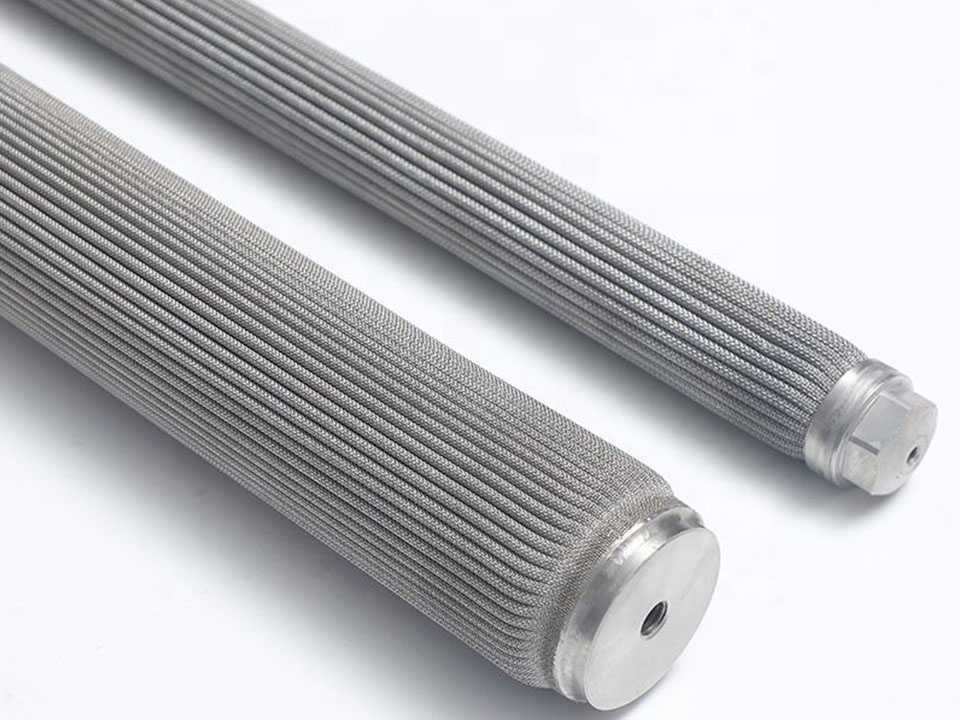
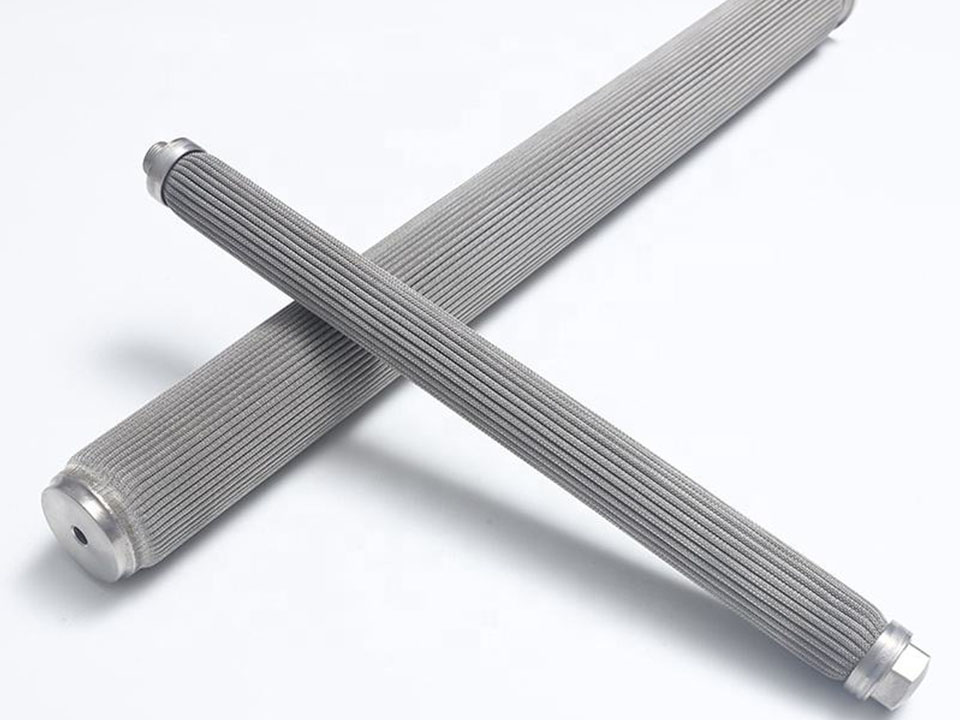
Sintered metal pleated cartridges apply the same principle with metal media. Fibers or woven layers are bonded by sintering into a porous sheet, which is pleated and welded or joined to metal end fittings and a core. Because the media is metal, these elements are generally considered where temperature, pressure cycling, aggressive fluids, or cleaning and reuse are concerns. As one example of how a manufacturer describes the concept, Porvair’s pleated sintered metal fibre cartridge data sheet lists fully welded construction without adhesives or fillers, a pleatable structure that offers more filtration area per cartridge, and in-situ cleanability. Those statements apply to that product, not to every pleated metal cartridge.
A micron rating alone does not define a pleated filter. A useful specification covers:
Process fluid and chemical compatibility. Name the fluid, concentration, and cleaning chemicals. Compatibility has to be checked against the actual fluid, not assumed from a material category.
Contaminant profile. Particle size range, concentration, and whether solids are hard, soft, oily, or sticky.
Retention requirement and rating basis. Nominal and absolute ratings are not interchangeable, and test methods differ. Ask how the rating was determined.
Flow rate and pressure drop limits. State the design flow, viscosity, allowable clean pressure drop, and the differential pressure at which the element must be cleaned or replaced.
Temperature and pressure. Include normal and peak operating conditions, plus the differential pressure the core must withstand.
Dimensions and connections. Length, outside diameter, end fitting or seal style, and gasket material.
Cleaning or replacement method. Backflushing, ultrasonic cleaning, chemical cleaning, or disposal each place different demands on the pleat design.
Flow direction. Outside-in or inside-out, matched to the housing.
Common Specification Mistakes
Sizing by micron rating only. Two elements with the same rating can differ widely in area, pleat design, and pressure drop.
Ignoring viscosity. Pressure drop rises with viscosity, so a cartridge sized on water may underperform on a thicker fluid.
Choosing the highest pleat count. More pleats may add area on paper but can reduce effective use of it.
Overlooking cleaning access. A cartridge that is designed for reuse still needs a cleaning method that reaches the contaminant.
Skipping the housing check. Sealing arrangement and flow direction must match the vessel.
FAQ
Do pleated filters remove smaller particles than non-pleated filters?
Not by themselves. Pleating adds area; it does not change the pore structure. Retention is determined by the media and operating conditions, which is why a pleated and a non-pleated element of the same rating are usually compared on flow and service life rather than on particle size.
Do pleated filters last longer?
Often, because more media area gives solids more room to accumulate and keeps velocity lower. Actual life depends on contaminant load, particle type, media, and the pressure-drop limit you set.
Can pleated filters be cleaned and reused?
It depends on the construction. Polymer and glass fiber pleated cartridges are generally replaced. Sintered metal pleated cartridges are often designed for cleaning, but results depend on the contaminant, the media, and the cleaning method, so confirm this with the manufacturer for your fluid.
What is the downside of a pleated design?
Pleat packs can be harder to clean than flat or plain cylindrical elements, and crowded pleats may restrict flow channels or load unevenly. Pleated cartridges also cost more to manufacture than simple tubes, so the area gain has to justify the added complexity.
Which is better, a pleated or a non-pleated sintered filter?
Neither is universally better. Pleated elements fit high-flow or compact installations where area is limited. Non-pleated sintered tubes or cylinders may suit duties that need simplicity, high mechanical strength, or easy cleaning. The deciding factors are flow, pressure drop, fluid, and the cleaning plan.
Conclusion
Pleated filters work by trading a simple flat or cylindrical media surface for a folded one, which increases the area available for filtration without enlarging the housing. The benefit is lower velocity, lower pressure drop at a given flow, and more room for solids. The limits are real, too: pleat spacing, uneven loading, and cleaning access can erode the gain if the design is pushed too far. The right choice comes from matching media, pleat design, and cleaning method to the actual fluid and contaminant.
If you are evaluating a pleated sintered metal cartridge, send CFC Filtration your fluid, contaminant, flow rate, pressure-drop limit, temperature, pressure, and housing details. A clear duty description makes it much easier to discuss suitable media, cartridge geometry, and end-fitting options.