Antes de terminar, convidamo-lo a falar diretamente com a nossa equipa de gestão para garantir que recebe o aconselhamento técnico mais preciso, apoio em matéria de preços e opções de personalização para o seu projeto. Os nossos especialistas podem avaliar rapidamente as suas necessidades, recomendar soluções adequadas de filtros de plástico sinterizado e ajudá-lo a reduzir os riscos de abastecimento, melhorando simultaneamente a eficiência, a consistência e a estabilidade do abastecimento a longo prazo para as suas aplicações industriais.
Precisa de ajuda para escolher o cartucho de filtro certo?
A nossa equipa de vendas
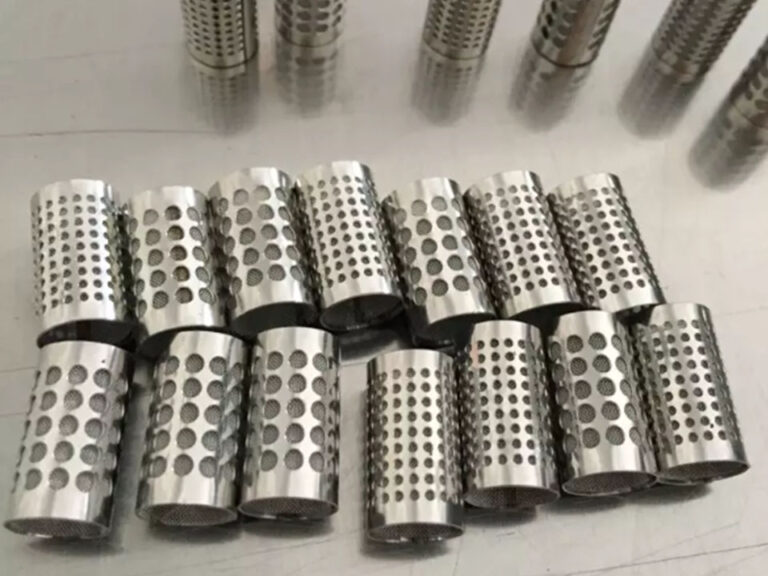
Indique à nossa equipa de apoio às vendas o tipo de produto, a classificação em mícrons, o tamanho, a aplicação, o meio filtrante, a temperatura de funcionamento, a pressão e a quantidade estimada. Ajudá-lo-emos a escolher o cartucho filtrante adequado, seja de plástico sinterizado, de metal sinterizado ou de sedimentos.
A PTFE filter is a filter whose filtration medium is polytetrafluoroethylene, a fluoropolymer known for chemical inertness, thermal stability, and natural water repellency. The term covers several different products. A thin expanded PTFE membrane and a rigid sintered PTFE cartridge are both “PTFE filters,” but they behave differently in the process line.
That distinction matters when you write a specification. A buyer who asks only for a “PTFE filter, 5 micron” leaves open the format, the wetting behavior, the mechanical strength, and the sealing method. Each of these can decide whether the element works in service.
How a PTFE Filter Works
PTFE does not do the filtering through any special chemistry. Like other particle filters, it retains solids mechanically: particles are intercepted at the surface or captured inside a porous structure. What PTFE adds is a medium that tolerates conditions in which many other polymers swell, soften, or degrade.
Two features define how PTFE behaves:
Chemical inertness. Fluoropolymer manufacturers document broad chemical and thermal resistance for PTFE. That is why PTFE is common in solvent, acid, and aggressive-process service.
Hydrophobicity. PTFE has a very low surface energy, so water does not spontaneously wet the pores. Air and gases pass through readily, while water is held back below a certain entry pressure.
The second point is easy to overlook. A hydrophobic filter in a water line may not pass liquid at all until the medium is wetted with a low-surface-tension fluid such as alcohol, or unless the PTFE has been treated to be hydrophilic. Sterlitech’s PTFE membrane data sheet describes the same behavior, noting that hydrophobic PTFE can filter aqueous solutions after pre-wetting with alcohol.
Main Types of PTFE Filters
PTFE Membrane Filters
Membrane filters use a thin, highly porous PTFE film, often expanded PTFE (ePTFE). They are supplied as discs, pleated cartridges, and vent elements. Because the film is thin, the surface does most of the retention, and fine pore ratings are practical. Laminated versions add a backing layer for handling and support.
Membranes suit applications such as vent filtration, sterile-grade air and gas filtration, solvent clarification, and laboratory sampling. The tradeoff is mechanical: a thin film depends on its support layer, pleat structure, and housing to survive pressure differentials and handling.
Sintered Porous PTFE Filters
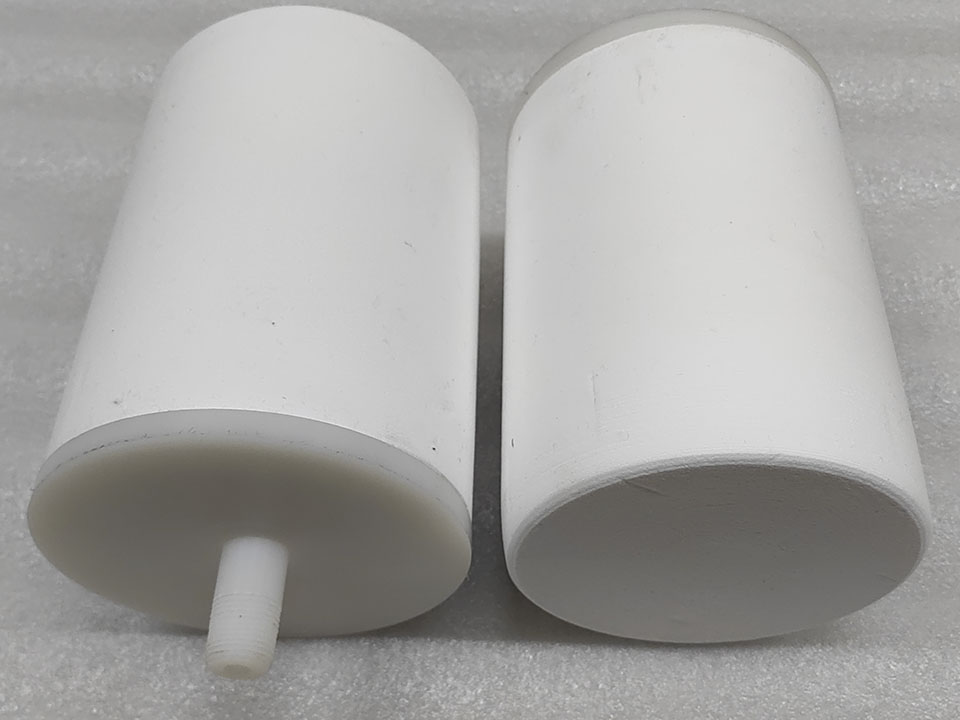
A sintered PTFE filter is made from PTFE powder that is pressed and heated so particles bond without fully melting. The result is a rigid element with an interconnected porous network. CFC Filtration describes its Cartucho filtrante sinterizado de PTFE as a depth-type element, with particles captured through surface interception and internal retention, and offers custom sizes and micron ratings on request.
Because the structure is a three-dimensional matrix rather than a film, a sintered element can be made as a tube, disc, cup, or custom shape. It can tolerate more mechanical handling than a membrane. It also holds more solids before pressure drop rises. It generally cannot reach the very fine retention of a membrane, and the pore-size distribution is broader.
Other PTFE Media
PTFE also appears as needle-felt and fiber media, for example in high-temperature gas and dust filtration. Those formats are outside the scope of cartridge-style liquid and gas filtration, but they explain why “PTFE filter” in a search or RFQ can mean several different things.
PTFE Filter Formats Compared
Fator
Membrana de PTFE
PTFE sinterizado
PE ou PP sinterizado
Estrutura
Thin porous film, often pleated
Rigid porous matrix
Rigid porous matrix
Retention style
Principalmente à superfície
Principalmente a profundidade
Principalmente a profundidade
Fine-retention potential
Highest of the three
Moderado
Moderado
Rigidez mecânica
Depends on support and housing
Self-supporting, but PTFE is a relatively soft polymer
Self-supporting, generally stiffer
Chemical and solvent scope
Very broad
Very broad
Narrower; depends on the specific polymer and fluid
Wetting by water
Hydrophobic unless modified
Hydrophobic unless modified
Behavior varies by polymer and treatment
Estrutura de custos típica
Varies with grade and housing
Usually higher than PE or PP
Usually lower than PTFE
The table is qualitative on purpose. Exact retention, flow, and temperature limits depend on the manufacturer, pore grade, and geometry, and they should come from the supplier’s datasheet for the specific part.
Where PTFE Filters Are Used
PTFE becomes the practical choice when the fluid or the conditions rule out cheaper media. Common application areas include:
Aggressive chemical and solvent filtration, where PP or PE may swell, soften, or be attacked.
Filtragem de gases e de exaustão, where the hydrophobic structure passes gas but resists water and condensation.
Laboratory and analytical work, such as sample preparation and mobile-phase filtration.
High-purity processes, where a clean, chemically inert medium helps limit contamination from the filter itself.
Elevated-temperature service, where polyolefin media would reach their limits first.
PTFE is not automatically the better filter. Several practical limits deserve attention.
The material rating is not the system rating. Unlaminated PTFE membrane is described as stable to about 260°C (500°F) in the Sterlitech data sheet above. A finished cartridge also includes end caps, adhesives or welds, O-rings, support cores, and a housing. The weakest component sets the usable limit, and so do pressure, differential pressure, and geometry. A PTFE medium rated for high temperature does not make the whole assembly equivalent.
PTFE is mechanically softer than many engineering plastics. It can deform under sustained load. Thin walls, high differential pressure, and pulsating flow call for a support design suited to the element.
“Chemically inert” is not “compatible with everything.” PTFE has well-known exceptions, such as molten alkali metals and certain aggressive fluorinating agents at high temperature. For any real process, compatibility should be checked against the actual fluid, concentration, and temperature, not assumed from the material name.
Wettability can block flow. For aqueous service, confirm whether the PTFE is hydrophobic or hydrophilic-treated. Also confirm how the user will wet it, and whether the wetting fluid is acceptable in the process.
Micron rating is not a guarantee. A nominal rating describes typical retention, not that every larger particle is removed. If a system needs defined retention, the specification should state the test method and efficiency target. It should not rely on the rating alone.
What to Specify When Requesting a PTFE Filter
A complete request prevents most mismatches. Include:
Process fluid or gas, with concentrations and any cleaning chemicals
Operating and maximum temperature, including sterilization or cleaning cycles
Pressão de serviço e pressão diferencial prevista
Caudal necessário e queda de pressão aceitável
Target particle size and retention requirement, and how it will be verified
Wetting condition: liquid, gas, or vent service, and the water-exposure risk
Dimensões, ligações nas extremidades e sistema de vedação
Cleaning or replacement approach
Any regulatory or documentation requirements for the application
Treat regulated uses, such as pharmaceutical or food contact, carefully. Material claims and certifications should be confirmed with the supplier for the specific part, and not inferred from the PTFE label.
Perguntas frequentes
Um filtro de PTFE é hidrofóbico?
In its standard form, yes. PTFE resists wetting by water, so gases pass while water is held back below the water entry pressure. Hydrophilic-treated PTFE is also available for aqueous liquids. Check which version a datasheet describes.
É possível utilizar um filtro de PTFE para água?
It can, but plain hydrophobic PTFE usually needs pre-wetting with a low-surface-tension fluid such as alcohol, or a hydrophilic grade. Whether that suits your process depends on how clean the system must stay.
Até que temperatura um filtro de PTFE consegue suportar?
PTFE as a material has high thermal stability, and the Sterlitech data sheet cites about 260°C for unlaminated membrane. The usable limit for a cartridge depends on its seals, end caps, support structure, and pressure. Ask the supplier for the rating of the complete element.
How is a PTFE filter different from a PP filter?
PTFE offers a broader chemical and temperature scope and is hydrophobic. PP is generally lower in cost and common in water and many chemical applications, but it has a narrower resistance range. Neither is universally better; the fluid and conditions decide.
Can PTFE filters be cleaned and reused?
It depends on the format and the contamination. Rigid sintered elements may tolerate backflushing or chemical cleaning when the cleaning agent is compatible. Thin membranes are typically replaced. Confirm reusability for your specific element and fluid.
Does a PTFE filter remove dissolved contaminants?
No. A PTFE particle filter retains solids by mechanical retention. Dissolved chemicals require a different process, such as adsorption, ion exchange, or membrane separation.
Choosing Between Formats
The main decision is rarely “PTFE or not.” It is whether the application needs a membrane for fine surface retention or a sintered element for rigidity, depth loading, and custom geometry. After that comes wettability, then the limits of the assembled cartridge. Confirm the process fluid and conditions first. Then use PTFE where its chemical and thermal range justifies the cost.
If you are evaluating a PTFE filter for a solvent, corrosive-fluid, or gas application, send CFC Filtration your fluid, temperature, pressure, flow, and dimensional requirements. The team can discuss suitable materials, pore grades, and custom cartridge configurations for your system.